September 2026
WELCOME
Welcome to The Crazy Plan where our mission is to show that anyone can create unimaginable wealth.
Each month, we publish a blog providing readers with the financial education neeed to set out on their own journey to a bright financial future. We do this by following two plans, our Monthly Plan saves £50 a month for 10 years and our Lumpsum Plan starts with a one-off £10,000. Our aim is to turn each plan into $1 billion in one or two generations.
At first, making $1 billion seems crazy but once you realise it’s a journey then things change. We’ll save our first £50 and from there our wealth will build to $1,000, then $5,000, then $10,000 and then $50,000. One day, if we’re patient, we’ll have $100,000 and then we’ll be looking at $1 million. From there it will be onwards to our $1 billion goal. This journey of small steps is how what seems impossible becomes possible.
You can dig-in to our posts however you like or if you are completely new to investing, you may want to start with “1.0 Liftoff!” and go through them in order which is how we build the education. We hope to provide you with the knowledge needed to set out on your own journey to a bright financial future if you choose. You can also visit the “About” page on our website to learn more about our plan.
All readers must read and agree to our Terms & Conditions, including the Disclaimer, which can be found on the T&C page of our website: https://thecrazyplan.com
ON WITH THE PLAN
Our Lumpsum Plan will be worth $1billion in: 75yrs 10mths
Our Monthly Plan will be worth $1billion in: 85yrs 9mths
Please subscribe for free to receive our posts by email using the Subscribe box at the top of our website!
Last month we looked at how to research investments and build a watchlist and covered two main areas which were general research and calculating our four core metrics. For general research we discussed using spreadsheets, key search examples, how to read candlestick charts, using an initial return filter and websites that provide historical price information. We then went through calculating our four core metrics and saw an excuse to give up if you’re not an expert in excel but we found a way around it by using only 13 prices and a couple of dates.
This month we’re going to have a look at some of the key areas to think about when you’re looking to open an investment account so you can buy and sell investments. First though, we’re going to have a think about The Great Wall of China for a little bit of motivation and belief.
THE GREAT WALL OF CHINA
We’re pretty sure you’ve heard of the Great Wall of China but have you ever thought about what a remarkable achievement it actually is? It’s 21,196km (or 13,171 miles) long so would go half way around the world and the terrain it covers is just as remarkable, towering over mountains and across deserts. Can you imagine being one of the first engineers or labourers and being told you were going to build such a huge wall? You would have laughed and thought it impossible! However, one day a bricklayer laid the first single brick and from there the wall rose. Day by day, month by month, year by year, decade by decade, century by century, more and more bricks were laid and the wall slowly rose out of the landscape.
The goal of a bright financial future from just £50 a month (or if you’re fortunate enough, £10,000) might seem just as impossible. However, when you start to think about laying bricks then things change. Our bricks are £50 a month, two hours of research a week and good money habits. If we just keep laying these bricks from month to month, year to year, then then just as the Great Wall slowly grew out of the landscape so our wealth will grow too. A bright financial future is possible for anyone, just keep laying bricks, be patient and unimaginable things can be achieved.
HOW TO BUY INVESTMENTS
So far, our posts have all been about choosing investments but now we need to think about how to actually buy and sell funds and shares. In post “1.6 Stock Markets” we said we can buy shares on a Stock Exchange and pretty much left it at that. It doesn’t matter what your wealth is, right from the start you need to think as though you are wealthy. You must treat building wealth professionally, otherwise a few years down the line you could be facing a large tax bill or find someone has run off with your money. We don’t just need to build wealth, we must protect it too. In this post we’ll look at the following areas:
- Finding a Platform Provider
- Regulation
- Types of Account
- Costs
- Other Considerations
- Future Generations
- Tax
These are areas that you should regularly re-visit from time to time as keeping your wealth safe, optimising how you invest and maximising CAGR after all costs and taxes are essential for success.
FINDING A PLATFORM PROVIDER
Shares are bought and sold on a Stock Exchange but unfortunately, we can’t access a Stock Exchange ourselves so we need to find someone who can and they’re called a Stockbroker. Once we have instructed our stockbroker to buy shares, we then we need to keep them somewhere. Years we would be sent a paper share certificate which we could keep under the bed but nowadays, shares are held electronically. That means we need to find someone who can hold our shares for us and keep them safe and we’ll call these people Platform Providers. To make life easy, we’re going to say that a “Platform” is a Platform Provider and Stockbroker all rolled into one as this is how it will appear when we set up a share dealing account.
Once we’ve chosen our Platform and set up our brokerage account with them, they provide all the tools we need to buy and sell shares and keep our investments safe. We access these tools and can see our portfolio either through their website, app or on the phone. So, how do we find these Platforms? The easiest way is to do a simple search online, for example:
- Top 10 Investment Platform Providers in [put your country here]
The search will come up with websites of Platforms and also lists of Platforms which are useful. Often though, the search for some reason misses out a key area to look at as well and that’s your bank. Most high street banks who you bank with day-to-day offer sharedealing services and so it’s definitely worth including them in your search as they can often have low costs. So now we have a list of Platforms, what key areas do we need to think about when deciding between them?
REGULATION
Just as keeping our share certificates under the bed was perhaps not the safest thing to do, it’s no different just because shares are held electronically. The most important thing is that our wealth is protected. It doesn’t matter if a Platform is vastly cheaper than any others, if our investments will not be safe then we won’t go near it.
What that means is that we want our Platform to be something called regulated. Regulated means that there are laws in place that are set by government mandate that the Platform has to abide by. For example, the Platform needs to have systems and processes to keep your investments safe. If you don’t know who the financial regulator is in your country then a quick search will tell you, for example:
- Financial regulator for share dealing in [put your country here]
In the UK it’s the Financial Conduct Authority (“FCA”) and yes, this is very boring. However, it’s a few minutes to check the Platform is regulated and the alternative outcome of not doing this does not bear thinking about.
TYPES OF ACCOUNT
When it comes to Platforms and types of brokerage account, you can go for gold, silver or bronze services. The gold service might be a wealth manager who makes all the investment decisions for you so you give them your money and they take care of all the research and investing, you literally do nothing. The silver service might be where you can access research by the Platform’s analysts and discuss investment ideas with them. The bronze service is execution only so you do your own research and you use the Platform to just execute your trades and keep your investments safe.
Bronze is the cheapest option whereas a gold service normally means you pay a percentage of the value of your portfolio in fees each year. We put ourselves in the bronze category because we do our own research and just want our Platform to execute trades for us and keep our investments safe. If you feel you need more support then silver or gold may be for you but remember, gold doesn’t necessarily mean greater CAGR so make sure you check performance history.
There are several brokerage accounts you can use to buy shares and these will vary depending on which country you live in and also on the Platform as not all platforms will allow all accounts but we’ll have a look at the two main ones.
General Investment Accounts
These accounts can hold Cash and Equities which is what we need. Once you have set up your account you log in to the website or app and can transfer-in or withdraw cash, buy or sell investments and see all of your investments and what they’re worth. General Investment Accounts are really easy to set up and use but there is a catch and that’s tax which we’ll talk about later.
Tax Advantaged Investment Accounts
Sometimes governments want to encourage saving and investing and they do this by providing a specific investment account which is tax free. Clearly, if this type of account is available it’s worth exploring because as you will see later on, tax can have a rather dramatic impact on your wealth.
In the UK there’s a Stocks & Shares ISA (Individual Savings Account) which lets you invest a certain amount each year (currently £20,000), in the US there’s a Roth IRA (Individual Retirement Account), in Japan there’s a NISA (Nippon Individual Savings Account), in Canada there’s the Canada Revenue Agency TFSA and the list goes on. So, if there’s a government backed scheme to encourage you to invest by lowering taxes then you should definitely look in to it.
Other Accounts: Pensions
Pensions are another tax wrapper that are usually available. They can be highly complex and whilst the headline might be that you can save “tax free”, when you come to take your money out in retirement most of it is usually taxable. In a pension, your money is usually locked-in until a retirement date so you can’t touch it until then and this could be a good thing as resisting the temptation to spend is key so that compounding can work its magic. However, the downside is that as you can’t access your money easily so the ability to hand that baton to the next generation if you have children could be restricted. We’ll touch on this when we talk about tax below (why is tax coming up so much?).
Other Ways To Buy Shares
You might have heard of “Spread-Betting” and “Contracts for Difference.” These are products which allow you to enter into a “bet” or “contract” where the payoff is the same as if you had bought the shares. These products might seem attractive as you often only need to put down 20% of the money needed up front which sounds great but there are two problems.
The first is that if you only have 20% of the money needed then in reality, you can’t afford the stock or fund. This leads on to the second problem which is where does the other 80% come from? Well, the provider lends it to you and charges you interest. This can destroy your returns as if your investments make 10% you could walk away with only 3 or 4% once you’ve paid the interest costs. Remember, we have a plan and it does not involve borrowing money or leveraging.
COSTS
We’ll talk about costs for General and Tax Advantaged Investment Accounts. There are a number of costs we’ll have to pay when we invest and one of the most important things to understand is fixed versus percentage costs. With a fixed cost we know exactly how much it will be but with a percentage cost, it will grow as our wealth grows. As an example, a 1% fee when your wealth is £2,000 means a £20 cost but if your wealth is £1 million the cost is £10,000 for the same service. Be very careful on percentage costs and regularly review what costs you’re paying.
Annual Account Fees
Most Platforms will charge you an annual fee for running your Investment Account. Some providers charge a fixed fee and some a percentage, often with a cap so the fees don’t become too ridiculous. You should easily be able to get this information from their website. If you do a quick search online you might also be able to see comparison tables showing the costs of the major Platforms alongside each other which is really helpful.
Dealing Fees
When you buy or sell an investment there might be a dealing fee which is payable on every trade you do. This will vary by Platform with some charging exceptionally low or zero fees to incentivise you to use them or to trade frequently. We’re not in the “frequent trader” category, we’ve made a total of 12 buys and 2 sells over the last 2¾ years so when you’re evaluating fees, take into account how often you’ll trade. We estimate we’ll change between 2 and 4 investments each year which means 4 to 8 trades a year as each change is one sell (the old investment) and one buy (the new investment).
Holding Fees
If you buy Unit Trusts / Mutual Funds there could be an additional cost which we talked about back in post “2.2 Funds: Unit Trusts / Mutual Funds.” This is an additional cost your Platform might charge for holding your units and it’s usually a percentage cost, hopefully with a cap. Again, be careful as it can become large as your wealth grows.
Costs Summary
At the end of the day, it’s a balancing act of Annual Account Fees (plus Holding Fees) versus how many times you’re going to trade a year. Just make a rough estimate of each cost based on your wealth and then compare your estimated costs for each Platform and you can decide which to go with. Don’t forget to review this every couple of years as your wealth grows.
OTHER CONSIDERATIONS
Back in post “1.8 Investing Small Amounts & Correlation” we touched on fractional shares. If you remember, we had the problem that we couldn’t afford even a single share in CSP1 as its share price was £455 but we only had £30 to invest. Fractional shares are a potential solution and so if this is something that you might need, make sure you include it in your research of Platforms.
FUTURE GENERATIONS
As you know by now, here at The Crazy Plan we’re thinking in decades to build wealth. To achieve the goal of $1billion will more than likely mean passing on the baton to the next generation. If you have a family you could think about starting investing early for children, especially if there are Tax Advantaged Investment Accounts available for them. Additionally, Platforms often charge zero fees to encourage people to start saving and investing early for their children and over 18 years to adulthood, this fee saving can be significant.
TAX
In this post we’ve kept mentioning everyone’s favourite word, tax. The reason is that right from the start you should think about tax as it becomes a much harder problem to solve as your wealth grows. Depending on which country you live in, there could be three main taxes to think about and they are: Income Tax (normally paid on dividends); Capital Gains Tax (normally paid on the increase in value of an investment); and Inheritance Tax (paid on the value of your wealth when you die).
Let’s say you’re on the Monthly Plan and we give you a choice in 55 years’ time (Lumpsum Plan 45 years):
- You can have wealth of $10 million; or
- You can have wealth of somewhere between $5 million and $8 million.
Which would you choose? Paying tax of 20-50% on your wealth is by far the biggest cost you could face. Choosing a Platform with low costs is something we should do but those costs won’t even come close to the loss of wealth from tax if you don’t plan ahead. It’s easy to start-out thinking “oh, I hardly have any savings so tax isn’t a problem” but by the time you realise tax is a problem, well, it’s a problem.
We’ve talked about Tax Advantaged Investment Accounts already and so if they’re available to you then seriously consider starting to use them as soon possible, they could save you millions. If these types of accounts are not available in your country, governments often give annual allowances and reductions in taxes to encourage you to save and build wealth so you should research what’s available.
You might choose to ignore inheritance tax as you won’t be around to have to pay it but remember, our plan is to build inter-generational wealth. At some point we need to pass the baton on to the next generation and a huge tax bill on death would not be helpful. Looking into investing options for children as we’ve mentioned above is something that’s worth considering.
CONCLUSION
There’s a lot to think about and research in this post but it’s actually quite simple. Our approach would be to see if there’s a Tax Advantaged Investment Account available and if there is then seriously consider this option, even if you’re starting with your first £50. Then look at Platforms (make sure they are regulated) and get a rough estimate of the total annual costs based on your wealth for each and choose the one you like. Over the coming years, part of your research can then be on tax and reducing costs by switching Platforms if needed. At the end of the day, don’t forget our objective: maximise our CAGR after all costs and taxes.
We read an article this week about a couple in the UK who are putting £50 a month into a Junior ISA (a UK Tax Advantaged Investment Account for children) for each of their children. Just imagine, they might be doing The Crazy Plan and each child could have $10 million sitting tax free when they are 55 years old and an unimaginable $200 million when they are 75 years old. One generation, $50 a month, $200 million in retirement, perhaps we’re not so crazy after all…
THE INVESTMENT REPORT
For an explanation of The Investment Report and The Crazy Fund please see our post “1.1 The Deep End”
| Wed 30-Sep-26 | Monthly Plan | Lumpsum Plan |
| Cash last month £ | 101 | 0 |
| Cash Saved £ | 50 | 0 |
| Unit buys / sells £ | 0 | 0 |
| Total Cash £ | 151 | 0 |
| Units last month | 1,097 | 10,000 |
| Units bought / sold | 0 | 0 |
| Total Units owned | 1,097 | 10,000 |
| Unit Price £ | 1.8765 | 1.8765 |
| Fund Value £ | 2,059 | 18,765 |
| Total Wealth £ | 2,210 | 18,765 |
| FX Rate | 1.3250 | 1.3250 |
| Total Wealth $ | 2,928 | 24,864 |
| Estimated CAGR | 15.00% | 15.00% |
| Years to $1billion | 85yrs 9mths | 75yrs 10mths |
Just like The Great Wall, our £50 savings on the Monthly Plan are our bricks. We can already see our wealth growing on both plans and one day it will be more than people can possibly imagine. All this started with our first brick of £50 on the Monthly Plan and £10,000 on the Lumpsum Plan back in January 2024. Remember, bricks are not just the money we save into each plan, they’re our research each week and good money habits which include resisting the temptation to spend and being patient so compounding can work its magic.
THE CRAZY FUND
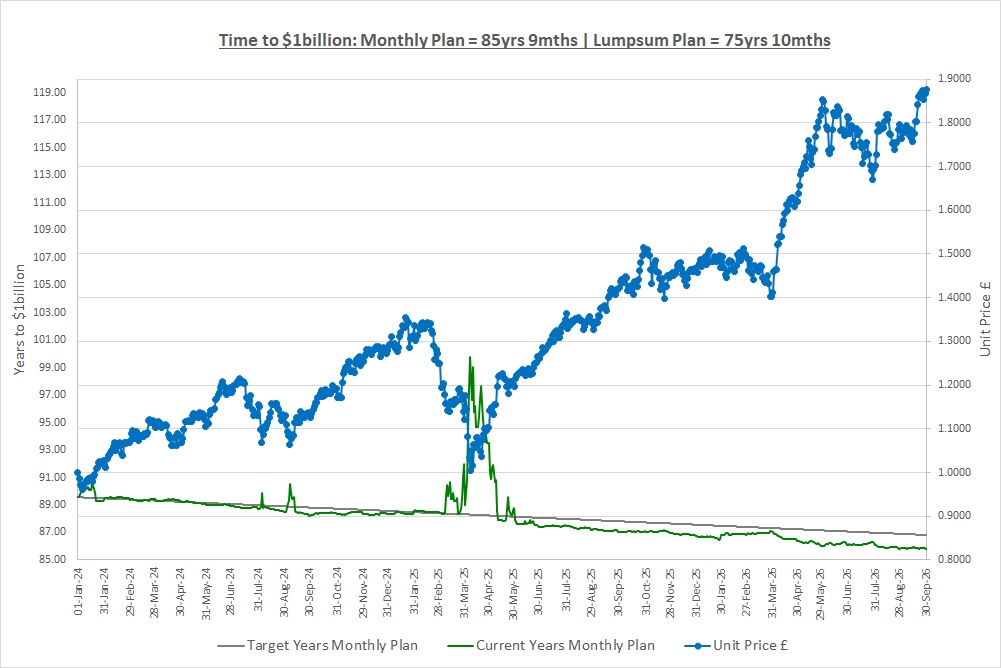
| Results | 28-Aug-26 | 30-Sep-26 | MTD Move | YTD Move | LTD Move |
| Unit Price £ | 1.7960 | 1.8765 | 4.49% | 28.10% | 87.65% |
| FX Rate | 1.3566 | 1.3250 | (2.33%) | (1.65%) | 4.15% |
| Unit Price $ | 2.4365 | 2.4864 | 2.05% | 26.00% | 95.43% |
| CAGR £ | 24.65% | 25.74% | 1.09% | 4.72% | 25.74% |
It was a very good month for our investments with them making 4.5% over the month and the crazy fund research portfolio hit a new high. Remember, we’re valuing our investments in GBP so to see how much we’re worth in USD (the definition of billionaire is $1 billion) we need to convert our wealth using the FX rate from GBP to USD. That moved against us during the month by just over (2%) resulting in an overall gain in our wealth measured in USD of 2%.
Below is a table of what the fund is invested in at 30/September:
| Ticker | % Fund | Price | CCY | Type | Description |
| LON:CSP1 | 9.0% | 62,698.00 | GBP | ETF | iShares Core S&P 500 UCITS (Acc) GBP Hedged |
| LON:JAM | 8.7% | 1,230.00 | GBP | IT | JP Morgan American Investment Trust PLC |
| LON:EQQQ | 9.4% | 56,335.00 | GBP | ETF | Invesco NASDAQ 100 UCITS GBP Hedged |
| LON:IITU | 10.3% | 4,071.00 | GBP | ETF | iShares S&P 500 Information Technology |
| LON:XDWT | 10.5% | 152.33 | USD | ETF | Xtrackers MSCI World Information Technology UCITS |
| LON:ATT | 10.9% | 771.00 | GBP | IT | Allianz Technology Trust PLC |
| LON:PCT | 11.8% | 699.00 | GBP | IT | Polar Capital Technology Trust PLC |
| LON:SMT | 10.4% | 1,590.50 | GBP | IT | Scottish Mortgage Investment Trust PLC |
| LON:OCI | 9.4% | 522.00 | GBP | IT | Oakley Capital Investments Limited |
| LON:XDEM | 9.4% | 7,556.50 | GBP | ETF | DB X-Trackers MSCI World Momentum Factor UCITS |
| Shares | 99.9% | ||||
| Cash | 0.1% |
- LON:EQQQ went ExDiv on 10/Sep and will pay on 17/Sep
A FAVOUR
If you find our posts helpful in building a bright financial future then in exchange, please sign up to receive them by email. The more people that subscribe the more we grow which means we can create more content to help you become unimaginably wealthy. You can sign up using the subscribe box at the top of our website: https://thecrazyplan.com
*** Please spread the word!
This blog is free as we want everyone to have access to financial education. We hope to inspire you to set out on your own journey to a bright financial future and if we do, in return please spread the word to others.
NEXT MONTH
Next month it’s time for our quarterly portfolio review and if you remember, our last review threw up a couple of possible new investments which we added to our watchlist. Even though these reviews might be a little repetitive and boring, they’re vital as we must make sure that over the years our portfolio doesn’t become stale.
DISCLAIMER
Please note that by the time this blog is published, we may no longer own some or any of the investments discussed. Strategies and investments discussed might be totally unsuitable for you and we are not recommending them to you, they should only be considered as ideas for further research. You must read and agree to our Terms & Conditions, including the Disclaimer, which can be found on the T&C page of our website: https://thecrazyplan.com
© TradeFloor Promotions Limited 2026

